
The Mechanics of Certainty.
Predictive analytics at Global Asia Forecast is not a black box. It is a rigorous, repeatable framework designed to filter regional noise into actionable market intelligence across Asian territories.
Standard Revision
2026.03.11
Multi-Source Triangulation
Reliable data forecasting begins with the aggressive validation of raw inputs. We do not rely on single-stream government reports or isolated commercial feeds. Our engine ingests data from three distinct vectors to ensure structural integrity:
-
Macro-Economic Indicators Direct APIs from regional central banks and customs registries across Singapore, Vietnam, and Indonesia.
-
Alternative Data Streams Satellite imagery for supply chain density, maritime AIS data, and localized sentiment analysis.
-
On-the-Ground Verification Manual validation checkpoints through our network of regional partners at Marina Boulevard.
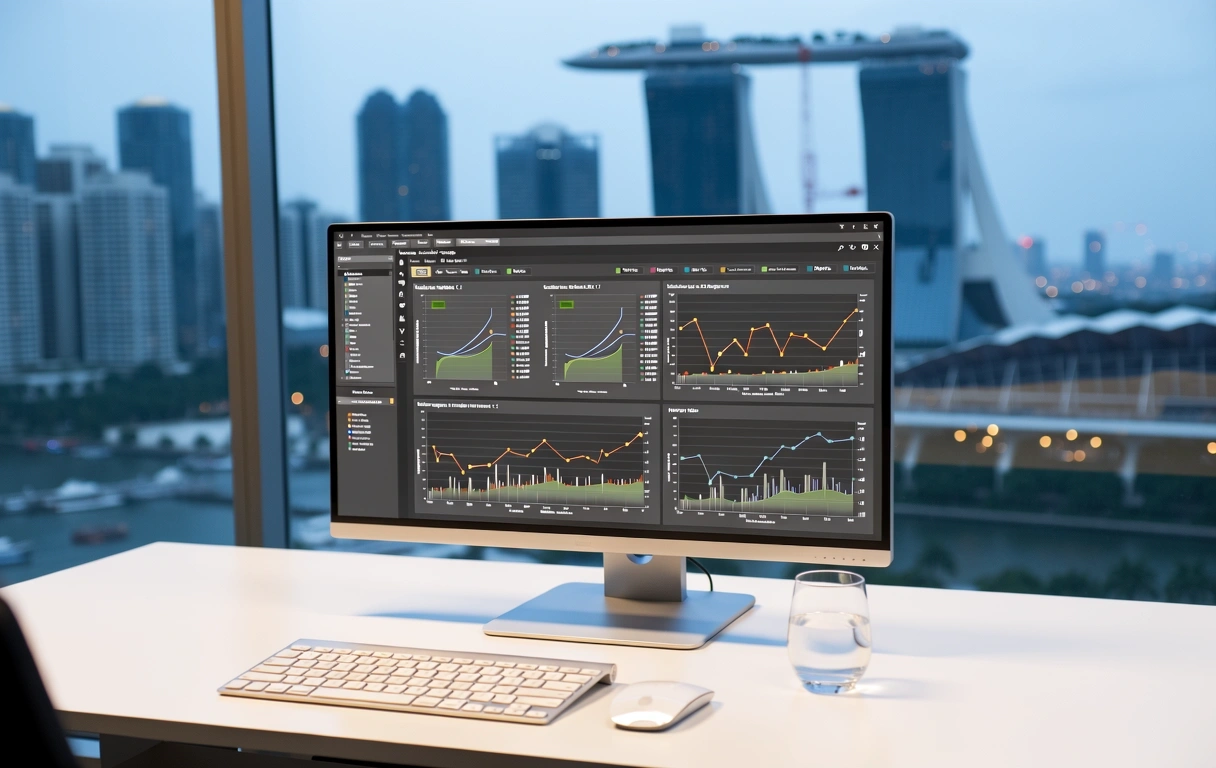
Evidence Well
"Every data point enters a temporary 'quarantine' where its origin, latency, and volatility are scored before it influences our predictive models."
Structural Modeling
Our analytics modeling begins with structural econometric frameworks. We define the baseline correlations that govern regional trade, such as currency fluctuations versus export volume.
Neural Refinement
Machine learning algorithms identify non-linear relationships that traditional models miss. This allows us to capture the "black swan" anomalies common in rapidly shifting Asian markets.
Bayesian Synthesis
The final forecast is a weighted probability distribution. This prevents the "false precision" of single-point forecasting and provides a range of potential outcomes.
Integrity Benchmarks
Historical Stress Entry
Every model is run against historical data from 2008, 2012, and 2020 to verify its ability to signal volatility before market realization.
Adversarial Review
Internal analysts specifically task models with "counter-narratives" to ensure the predictive analytics are not suffering from confirmation bias.
6-Hour Refresh
Models are recalibrated every 360 minutes to account for overnight trading in major Western markets and morning openings in East Asia.
Global Asia Forecast operates out of Singapore to remain at the temporal heart of the Asian market workday, ensuring zero-latency awareness of regional shifts.

Intelligence Without Intuition.
The Asian market is frequently modeled using Western assumptions. Our methodology is built from the ground up to respect localized factors—from ASEAN regulatory divergence to currency pegging behaviors. We remove the "western bias" typically found in global data forecasting systems.
Need a detailed Technical Whitepaper?
Our full modeling specifications—including algorithmic sensitivity coefficients and API source lists—are available to institutional partners under standard NDA.